
SI Joint Pain in Pregnancy: Causes and 6 Exercises for Relief
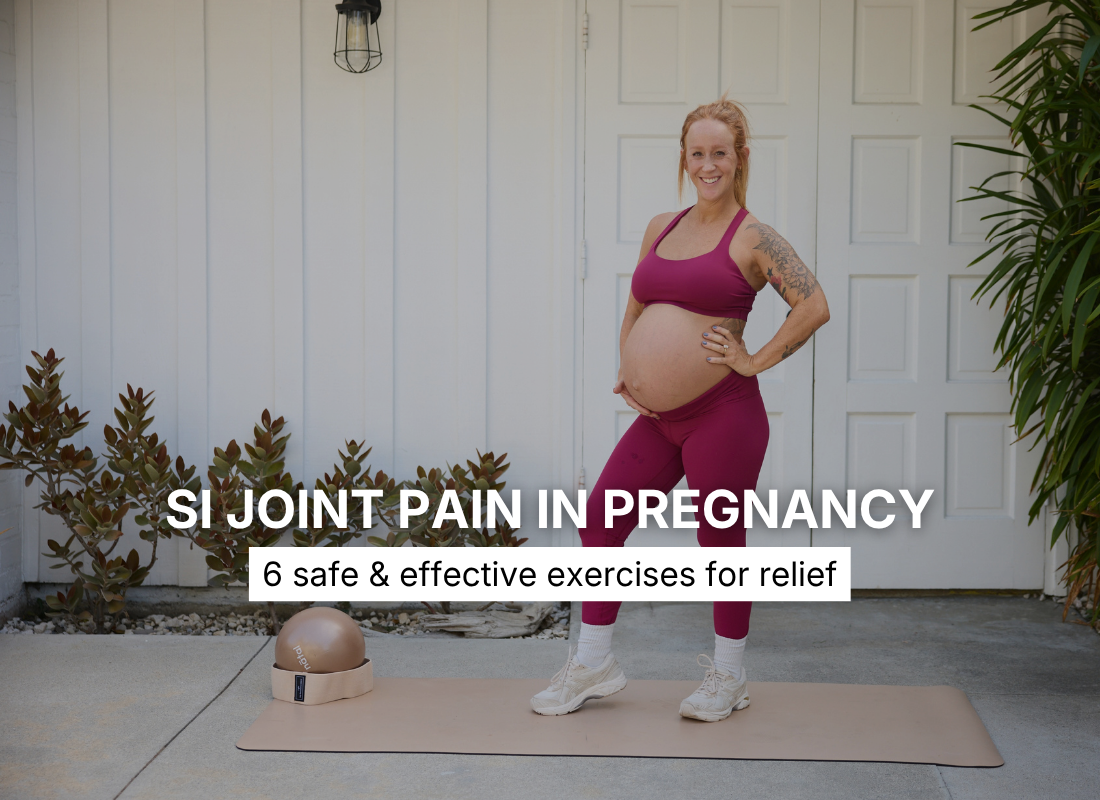
SI joint pain in pregnancy is a sharp or aching pain low in your back, just to one side of your spine, often right where the dimples above your butt are. It's very common: pregnancy hormones loosen the ligaments around your pelvis while your growing baby changes how you stand and move. Up to 50–70% of pregnant women deal with low back or pelvic pain, and the SI joint is one of the most common sources. You don't have to just push through it. SI joint pain usually responds best to strengthening your glutes and deep core, not just stretching. Below are 6 exercises and the everyday fixes that make the biggest difference.
What is the SI joint, and why does it hurt in pregnancy?
Your sacroiliac (SI) joints connect the base of your spine (the sacrum) to your pelvis, one on each side. They don't move much. Their job is to transfer load between your upper body and your legs.
In pregnancy:
- Hormones (including relaxin) loosen your ligaments so your pelvis can open for birth. Looser ligaments mean less passive stability.
- Your posture changes. Your center of gravity moves forward and your low back arch often increases.
- Your hip flexors and low back take over. They pull you into an arched, rib-flared posture that loads the SI joint.
- Your deep core and glutes get stretched or underused, so the muscles that should be stabilizing your pelvis aren't doing as much of the work.
The result: one joint can get irritated or move unevenly, especially with movements where you stand on one leg.
How SI joint pain feels, and how it differs from sciatica
SI joint pain usually:
- Sits low in the back, to one side, sometimes spreading into the butt or the back of the thigh
- Flares when you roll over in bed, get out of the car, climb stairs, stand on one leg to put on pants, or walk for a long time
- Feels like a sharp "catch" or a deep ache
Sciatica (an irritated sciatic nerve) is more likely to shoot down the back of your leg past the knee, and can come with tingling or numbness. Pain from a tight piriformis muscle deep in the butt can feel similar. Either way, the exercises below are gentle, but a physical therapist can tell you exactly what's going on.
6 exercises for SI joint pain in pregnancy
Move slowly and stay in a pain-free range. Do these 4–5 days a week.
1. 360° diaphragmatic breathing
Sit tall or lie on your side. Inhale and let your ribs, belly and pelvic floor expand. Exhale and gently lift your pelvic floor as your deep core wraps around your baby. 10 breaths. This switches on the deep core that stabilizes your pelvis, and you'll use it in every exercise below.
2. Glute bridge with a ball squeeze
Lie on your back (propped on pillows if needed) with your knees bent and a small ball or pillow between your knees. Exhale, squeeze the ball gently, and lift your hips. Inhale to lower. 2 sets of 10. The inner-thigh squeeze helps your pelvis work evenly on both sides. If lying on your back makes you dizzy or short of breath, do the clamshell on your side instead.
3. Side-lying clamshell
Lie on your side with your knees bent and a pillow under your bump. Keep your feet together and lift your top knee without rolling your hips back. 2 sets of 12 per side. This strengthens the glute muscles that keep your pelvis level when you walk.
4. Bird dog
On hands and knees, exhale and reach one arm and the opposite leg long, without letting your back sag, your ribs flare, or your hips tip. Hold for 2 breaths, then switch. 8 per side.
5. Wall sit or supported squat with a band
With a light band above your knees, slide down a wall or sit back toward a chair. Press gently out into the band and exhale as you rise. 2 sets of 8–10.
6. Seated glute release
Sit on a chair and cross one ankle over the opposite knee. Sit tall and lean forward slightly until you feel a stretch deep in your butt. Hold for 30 seconds per side. Skip it if it pinches at the SI joint.
What to go easy on: deep lunges, wide-legged stretches that pull your pelvis apart, standing on one leg for long periods, and single-leg exercises like step-ups, at least until the pain settles.
Everyday fixes that make a big difference
- Keep your knees together when you roll over in bed, get in and out of the car, and stand up from a chair. Move like a log, not a pair of scissors.
- Sleep with a pillow between your knees (and ankles) to keep your pelvis level.
- Sit to get dressed instead of standing on one leg to put on pants, socks and shoes.
- Take stairs one at a time, leading with your less painful leg going up and your more painful leg going down.
- Shorten your stride when walking, and split long walks into shorter ones.
Stop and call your provider if you notice:
- Vaginal bleeding or fluid leaking
- Regular, painful contractions
- Shortness of breath before you start, or dizziness or chest pain at any point
- Muscle weakness that affects your balance
- A headache that won't go away, or changes in your vision
- Calf pain or swelling
- Your baby moving less than usual
A pelvic health physical therapist can assess your pelvis and give you a targeted plan.
How nātal can help
nātal's Ab Prehab program is an all-trimester core and pelvic floor program designed to keep your pelvis supported and help prevent the aches and pains of pregnancy. Pair it with Bump Camp for full-body strength that follows ACOG guidelines.
ALL IN is a complete strength training system with a pregnancy version: progressive lifts with step-by-step demos, coaching cues and rest timers, plus deep core and pelvic floor work built in. It's the best fit if you want to lift on your own, at home or in the gym.
Getting closer to delivery day? Labor Prep trains labor positions, breathing techniques, pelvic floor prep and core stability for pushing. It's also built to help reduce back and pelvic pain in late pregnancy and set you up for an easier postpartum recovery.
Prefer something gentler? Pregnancy Yoga and Pilates combines restorative yoga flows with Pilates techniques that focus on stability and strength. It helps you connect with your deep core and reduce aches and pains, while improving circulation, support and mindset in pregnancy.
Start your free trial of nātal →
Keep reading:
- Pregnancy Posture Exercises for Back and Pelvic Pain
- Safe Core Exercises During Pregnancy: What to Do and Avoid
This article is for education and isn't medical advice. Talk to your provider before starting a new exercise routine in pregnancy.
Find your
perfect plan


