
Tight Pelvic Floor: Signs and How to Relax It
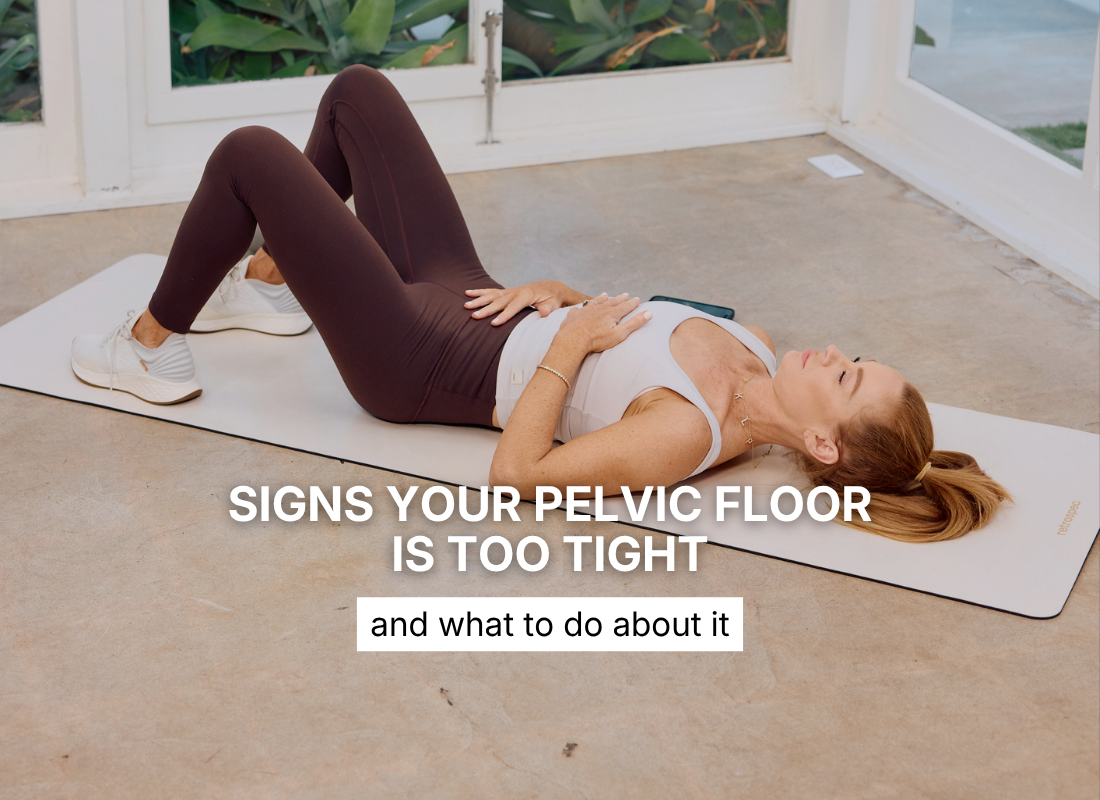
A tight pelvic floor, also called a hypertonic or overactive pelvic floor, is one that holds tension when it should be resting. It can feel like pressure, pain or leaking, so it's easy to mistake for weakness. That's why so many moms are told to "just do kegels" and then feel worse. That's not you doing it wrong. It's the wrong strategy. The fix starts with learning to let go before you strengthen.
Here's how to tell whether your pelvic floor might be too tight, why it happens in pregnancy and after birth, and what to do about it.
What is a tight (hypertonic) pelvic floor?
Your pelvic floor is a group of muscles that sits like a hammock at the bottom of your pelvis. A healthy pelvic floor moves: it lifts and tightens when you need support (a cough, a sneeze, lifting your baby) and it lengthens and relaxes when you breathe in, pee, poop and have sex.
A hypertonic pelvic floor gets stuck in "on." It is always partly clenched, so it has nowhere left to contract when you actually need it. Tight doesn't mean strong. A muscle that can't relax can't do its job either.
Signs your pelvic floor might be too tight
You might have a tight pelvic floor if you notice:
- A "tight but weak" feeling, or heaviness and pressure in your pelvis
- Pain with sex, inserting a tampon, or pelvic exams
- Constipation or straining to poop
- Trouble starting your stream, or feeling like your bladder never fully empties
- Urgency (a sudden "I have to go NOW")
- Leaking, even though you've been doing your kegels
- Aching in your hips, tailbone, low back or groin
- Lower belly bloating
These symptoms overlap with other conditions, so they aren't a diagnosis. If several sound familiar, it's worth getting checked by a pelvic floor physical therapist.
Tight vs. weak pelvic floor: what's the difference?
- What the muscle is doing
Tight (hypertonic): Holding tension, can't fully relax
Weak (hypotonic): Overstretched or underactive, can't fully engage - Common symptoms
Tight (hypertonic): Pain with sex, constipation, urgency, trouble emptying, "tight but weak"
Weak (hypotonic): Leaking with sneezing or jumping, heaviness, prolapse symptoms - Are kegels the answer?
Tight (hypertonic): No. They can add more tension
Weak (hypotonic): Not on their own. Strengthen with breath, deep core and progressive movement - First step
Tight (hypertonic): Release, lengthen and down-regulate
Weak (hypotonic): Connect, then progressively strengthen
Plenty of moms have a bit of both: tight in some areas, weak in others, and out of sync with the breath. That's why it helps to start by restoring full range of motion before adding strength.
Why does the pelvic floor get tight in pregnancy and after birth?
- Guarding. Your body braces to protect itself: from the growing weight of pregnancy, from pain or tearing during birth, or from the fear of leaking.
- Bracing and sucking in. Holding your belly in all day pushes your pelvic floor into a constant clench.
- Shallow breathing and stress. When you breathe high in your chest, your diaphragm and pelvic floor stop moving together. Sleep deprivation and stress also keep your nervous system, and your pelvic floor, on high alert.
- Scar tissue. Tearing, an episiotomy or a C-section scar can change how the tissues around your pelvis move.
- Too many kegels. Squeezing over and over without ever fully relaxing trains the muscle to stay switched on.
5 ways to relax a tight pelvic floor
Go gently. You should feel ease, not effort. Practice daily, and stop anything that causes pain.
1. 360° diaphragmatic breathing
Lie on your back with your knees bent, or sit tall. Place your hands around your lower ribs. Breathe in through your nose and let your ribs expand out to the sides and back, and let your belly soften. As you inhale, picture your pelvic floor gently widening and dropping, like a flower opening. Exhale slowly and let everything return. Do 10 breaths, twice a day.
This is the foundation. Your diaphragm, deep core and pelvic floor work as one pressure system, so every full inhale is a small pelvic floor stretch. Learn more in Stop Bracing, Start Breathing.
2. Happy baby
Lie on your back and bring your knees toward your armpits, holding your feet, ankles or shins. Let your tailbone stay heavy on the floor. Breathe into your pelvic floor for 5–8 slow breaths. In pregnancy, prop your head and shoulders on pillows, or do it side-lying if lying on your back is uncomfortable.
3. Child's pose with breath
Kneel with your knees wide and fold forward over a pillow or bolster. Breathe into your back ribs and feel the pelvic floor lengthen with every inhale. Hold for 1–2 minutes.
4. Deep supported squat
Hold onto a counter or sit on a yoga block. Sink into a wide squat with your heels down. Inhale and let your pelvic floor relax down; exhale and gently rise a few inches. Repeat 5–8 times.
5. Hip and inner-thigh release
Tight hips and inner thighs pull on the pelvic floor. Try a gentle butterfly stretch, or lie on your back with your knees bent and let them fall open, supported by pillows. Breathe slowly for 1–2 minutes.
A note on kegels: once your pelvic floor can fully relax, strengthening is the next step, but not with endless kegels. Real strength comes from training your whole core and pelvic floor through their full range: a full lift and a full release, timed with your breath and built into real movement. If you can't feel the let-go yet, stay with release work for now. Read more in Postpartum Kegels: Do or Don't?
When to see a pelvic floor physical therapist
Book a visit with a pelvic floor PT (and let your OB or midwife know) if:
- Sex, tampons or exams are painful
- Symptoms are getting worse, or aren't improving after a few weeks of gentle release work
- You have ongoing constipation, trouble emptying your bladder, or pelvic pain
- You feel a bulge or "something falling out"
A pelvic floor PT can do an internal assessment to tell you exactly what's tight, what's weak and what needs to come first.
How nātal can help
nātal's Hypertonic Pelvic Floor Program is built for exactly this. It's all-trimester safe, and it starts with release techniques and breath work before moving into gentle pelvic floor strength. After birth, Ab Rehab Phase 1 begins in the same place, with deep activation, breath, and guided mobility to lengthen and relax, then rebuilds your core and pelvic floor step by step. Along the way, you get live in-app coaching from expert postpartum coaches and licensed physical therapists.
Start your free trial of nātal →
Keep reading:
- Postpartum Pelvic Floor Recovery: Why Kegels Aren't Enough
- Diaphragmatic Breathing for Diastasis Recti Postpartum
This article is for education and isn't medical advice. Talk to your provider before starting a new exercise routine in pregnancy or postpartum.
Find your
perfect plan


